Showing posts with label Pentamerone. Show all posts

Monday, October 18, 2010

If Men Could Climb Hair...


(Photo credits: via www.reviewstl.com, Disney's Concept art for Rapunzel.)
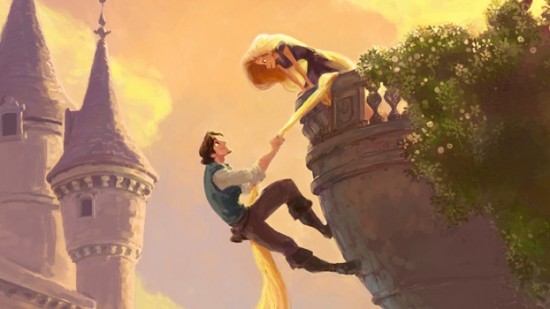
Oh, to be named after a food. In the story of Rapunzel, a woman longs for some lettuce, or some type of vegetable, from a garden that came be seen out her window. In the Grimm Brothers’ versions (there are two) of this story, the garden is owned by a witch. The woman’s husband sneaks into the garden and takes some of the vegetable that his wife is craving. In most versions of the story he is successful at first, but in a later attempt he is caught in the act by the witch. In Giambattista Basile’s The Pentamerone (a.k.a. The Story of Stories), Basile includes a story called Petrosinella. In his version the woman goes herself into the garden and the witch is actually an ogress. In “The Fair Angiola,” another Italian fairytale, seven women sneak into the garden, but only one is captured by the witch.

In each version, the owner of the garden demands the thief’s unborn child. The intruder is released, and after the child is born the witch/ogress comes to collect. Some versions say that the baby is traded right away, in other versions as much as seven years pass before the daughter is handed over to the witch. In most cases, the daughter is named for the food from the garden which the mother was craving. (Rapunzel is German for a type of lettuce; Petrosinella is Italian name meaning parsley.) The girl is taken by her capture and placed into a tower without doors or stairs. The only way in is through a window at the top. Each day when the witch comes, so that she can climb up, she calls for Rapunzel to let down her hair.

A prince eventually comes along and discovers the tower containing Rapunzel. In the Grimm’s versions the prince hears Rapunzel singing and is captivated. In other versions the prince sees her in the tower. After troubling over a way into the tower the prince eventually sees the witch come and call for Repunzel to send down her long hair. When the witch leaves the prince mimics the witch’s call and Rapunzel complies. When the prince comes through the window Rapunzel is shocked, but she quickly recovers. In the Grimm Brothers’ first edition of the story, included in their 1812 release, the prince comes back daily. Eventually Rapunzel gets pregnant and the witch discovers what has been going on. In the 1857 release of the story the Grimm Brothers change the story so that rather than getting pregnant, Rapunzel merely slips up and accidently mentions the prince to the witch. The witch cuts off Rapunzel’s hair and sends her away into the wilderness. When the prince returns, the witch lets down Rapunzel’s hair. The prince reaches the top and finds the witch. She tells him that he’ll never see Rapunzel again, and in distress he falls from the tower. He somehow lives, but the fall has made him blind. These versions of the tale are resolved by the prince wandering blindly for years until he comes to the wilderness where Rapunzel has been living. When she sees him she runs to him, hugs him, and cries. Her tears fall on his eyes, and his sight returns.

In other versions, as in the tale of “The Fair Angiola,” the prince proposes marriage when they first meet. Angiola (the Rapunzel character) agrees, and, after stealing three magical balls of yarn from the witch’s things, Angiola and the prince make their escape that very night. In “Petrosinella,” Parsley is trapped in the tower by magic and is unable to run away with the prince. The two lovers continue to meet until Parsley overhears the way to break the enchantment. She takes the three gallnuts that are the key to her freedom and runs away with the prince. The escape is discovered by the witch/ogress in both tales. The captor chases the couple and is about the catch up with them. But Angiola/Parsley uses the witch’s/ogress’ magic against her. In each story the girl throws down the magical balls one by one. In Parsley’s story, the first gallnut produces a bulldog, the second a lion, and the third a wolf. The wolf eats the ogress and the prince and princess are married. When Angiola throws down the balls of yarn, the first one creates a mountain of soap, the second a mountain of various sized nails, and the third a rushing river. Thwarted by the river, the witch curses Angiola with the face of a dog and returns home. The prince, believing that his parents would never let him marry Angiola as long as she was under the curse, hides her away in a cabin (basically he thinks his parent won’t let him marry someone so ugly.) Distraught, Angiola cries to her pet dog that came with her when she left the witch’s tower. The dog then goes to the witch and begs her to remove the curse. She eventually capitulates and Angiola is made even more beautiful than she was before. The prince sees that she is beautiful again and takes her to the king and queen who “were so pleased with her beauty that they welcomed her.”


Check out the stories for yourself:

The Grimm Brothers' "Rapunzel"(1857)

A comparison of the Grimm Brothers' First and Final Editions of Rapunzel

Thomas Frederick Crane's "The Fair Angiola"

Giambattista Basile's "Petrosinella," from The Pentamerone

Citations:

Zipes, J. (2000). The Oxford companion to fairy tales: The western fairy tale tradition from medieval to modern. New York; Oxford University Press.

Warner, M.(1994). From the beast to the blonde: On fairy tales and their tellers. New York; Farrar, Straus and Giroux.

Ashliman, D. (2010). Grimm brothers’ home page. Retrieved from http://www.pitt.edu.

Heiner H. (1999). SurLaLune fairy tales. Retrieved from www.surlalunefairytales.com.

Monday, September 27, 2010

"Tell me, glass, tell me true..."


(Photo Credit: "Snow White" by Josephine Wall, Celestial Journey - Fantasy World of Josephine Wall (Vol.01) #19)

Among the many folk and fairy tales of women held captive by a magically induced sleep is the story of Snow White. The more recent versions of this narrative used in adaptations for stage and film relate more closely to Jacob and Wilhelm Grimm’s German version of the tale included in their collection Children’s and Household Tales (1812-1815). Iona and Peter Opie mention in their collection, The Classic Fairy Tales, that the story of Snow White was retrieved from two sisters, Jeannette and Amalie Hassenpflug, by the Grimm Brothers in Cassel. Themes from Snow White, including jealousy, poisoning, and a glass coffin, can be found in Giambattista Basile’s Pentamerone(1634-6), day 2 tale 8, “The Young Slave.” With slight variations, similar stories to Snow White have been found in many locations including Africa, Asia Minor, Scandinavia, Ireland, Russia, Greece, Serbo-Croatia, the Caribbean, and North, South, and Central America.

Despite the changes in the different relations of the story, the basic frame remains the same. Snow White’s origin is a magical affair in most every version. In some accounts, such as the Grimm version, the mother pricks her finger and three drops of blood fall on the white snow. This leads Snow White’s mother to wish for a daughter as white as snow, as red as blood, and as black as ebony. This wish is granted, although the “granter” of the wish is, in most cases, unknown. In some versions of the tale the mother eats something, a pomegranate seed or a tangerine, after which she finds herself with child. In Basile’s Pentamerone, the mother eats a rose leaf. After Snow White’s birth, or appearance, her mother dies.

In a majority of the accounts, Snow White’s father remarries, and her beautiful, proud stepmother enters the plot. In the Grimm Brothers’ version the stepmother has a magic mirror. The stepmother often asks the always truthful mirror who in the land is most beautiful. At the beginning of the tale the answer is always the stepmother, but her beauty is surpassed by the Snow White when she reaches seven years of age. In other editions the stepmother overhears some of the palace guests and/or passers-by declare that the Snow White is more beautiful that the stepmother. Others say the stepmother consults an omniscient trout. Out of jealousy the stepmother gets rid of Snow White either by banishment or death. In most renditions the stepmother instructs a servant, sometimes noted as a hunter, to take Snow White into the woods and kill her. The stepmother requests that the hunter bring back a piece of the child to prove her death. In some instances the stepmother asks for the child’s lungs, or liver, or intestines, her hands, her eyes, her tongue, her hair, or bottle of her blood. In the Disney adaptation the Queen asks for the little girl’s heart. The hunter character takes Snow White out into the woods, but, after the child pleads for her life, he lets her go and kills a boar (or a dog, or a stag) in her place. In some relations, when the hunter returns, the stepmother goes as far as to eat the piece that he brings to her.

Evading death, Snow White finds a cottage, or dwelling, in the woods. Upon entering she sees a table set for seven with bread and wine. She proceeds to eat a small bit of bread from each place, and drink a sip of wine from each cup. Then she finds seven beds, and tries all of them until she finally falls asleep in the last one. And that is where the owners of the home, seven dwarfs, find her when they return. Different variations on the owners of the house include: thieves, woodsmen, ogres, Jinns, bears, bandits, giants, monkeys, cannibals, brothers, wild men, old women. After seeing her, the dwarfs decided to let her sleep. When she wakes up, Snow White shares her story and the dwarfs agree that she can stay if she’ll tidy up the place, wash the dishes, and cook.

In the mean time, the child’s stepmother has discovered that Snow White is alive, and is filled with rage and jealously. In the Grimm version of the tale, the stepmother disguises herself and goes to the house of the dwarfs. In some instances the stepmother sends others to deal with Snow White. Despite the warning of the caretakers, Snow White lets her stepmother, dressed as a peddler, into the house. The first time the stepmother comes she sells Snow White a ribbon for her stays, and then laces Snow White up so tight that she stops breathing. But the dwarfs find Snow White when they return and cut her free from the trap, restoring her to life. After discovering that Snow White is still alive the stepmother returns. The second time she offers Snow White a comb, the same element is used in “The Young Slave.” The third time the stepmother gives Snow White a poisoned apple, and that seems to do the trick. In other version Snow White is poisoned with flowers, corsets, shoes, raisins, grapes, needles, rings, belts, neckbands, shirts, wine, gold coins, headbands, hats, cakes, white bread, and brooches. In J.K. Musäus’s Jolksmärchen der Deutschen (1782), the stepmother, the Countess of Brabant, has Snow White poisoned by a physician using pomegranate soap, and then a poisoned letter. In the Disney adaptation, the writers cut to the chase and go straight to the poisoned apple. In any event, Snow White’s guardians return to find her dead, and this time they aren’t able to revive her.

Because she doesn’t seem to be decaying, and because she is so beautiful, the dwarfs place her in a glass coffin. In the Pentamerone the girl, Lisa, is placed in seven nested crystal cases. As time passes Lisa continues to age and the cases grow with her. This is something that is not explained in other versions of the tale. However, Lisa is only in the coffin a year or so. After some time a prince, or a hunter, or a nobleman, discovers Snow White in the coffin. He asks the caretakers if he can have the girl and coffin, and, after some debate, they agree. When the coffin is moved the apple is dislodge from Snow White’s mouth and she wakes up. The prince is elated and asks Snow White to marry him. In the Disney version she is awakened by a kiss from the Prince she saw at the beginning of the story. In “The Young Slave” Lisa is awakened when her jealous aunt opens the coffin and removes the comb from her hair. Lisa is forced to work as a slave until her uncle discovers that she is, in fact, the daughter of his sister. The uncle then forces his wife to return to the house of her parents, and when Lisa is of age he gives her in marriage to a “handsome and worthy husband whom she loved.” In the main story of Snow White it’s curious that the girl is old enough to marry by the time she is discovered by the prince. Although it is not addressed, at some point in the story lengthy amounts of time in which Snow White is growing, must occur. It is left up to the reader to determine when this growth occurs.

Snow White’s recovery is discovered by the stepmother she is “choked with passion,” and dies. In some cases she attends Snow Whites wedding, where she discovers that the girl is alive. Then the stepmother is forced to put on red-hot shoes and dance until she dies.

The story of Snow White is used to convey the harms of jealousy, and to warn its listeners and readers against pride and envy. Basile’s Pentamerone describes jealousy, in prelude to the tale of “The Young Slave.”

"Jealousy is a fearful malady, and (sooth to say) 'tis a vertigo which turneth the brain, a fever burning in the veins, an accident, a sudden blow which paralyseth the limbs, a dysentery which loos eneth the body, a sickness which robbeth ye of sleep, embittereth all food, cloudeth all peace, shorteneth our days: 'tis a viper which biteth, a moth which gnaweth, gall which embittereth, snow which freezeth, a nail which boreth you, a separator of all love's enjoyments, a divider of matrimony, a dog causing disunion to all love's felicity: 'tis a continual torpedo in the sea of Venus' pleasures, which never doeth a right or good deed: as ye will all confess with your own tongues on hearing the story which follows."

Check out the stories for yourself:

The Grimm Brothers' "Little Snow-White"

Giambattista Basile's "The Young Slave" from The Pentamerone


Citations:

Zipes, J. (2000). The Oxford companion to fairy tales: The western fairy tale tradition from medieval to modern. New York; Oxford University Press.

Opie P., Opie I. (1974). The Classic Fairy Tales. New York, Oxford; Oxford University Press.

Warner, M.(1994). From the beast to the blonde: On fairy tales and their tellers. New York; Farrar, Straus and Giroux.

Owens, L. (1981). The Complete Brothers Grimm Fairy Tales. New York, Toronto, London, Sydney, Auckland; Crown Publishers, Inc., Random House.

Ashliman, D. (2010). Grimm brothers’ home page. Retrieved from http://www.pitt.edu.

Heiner H. (1999). SurLaLune fairy tales. Retrieved from www.surlalunefairytales.com.